

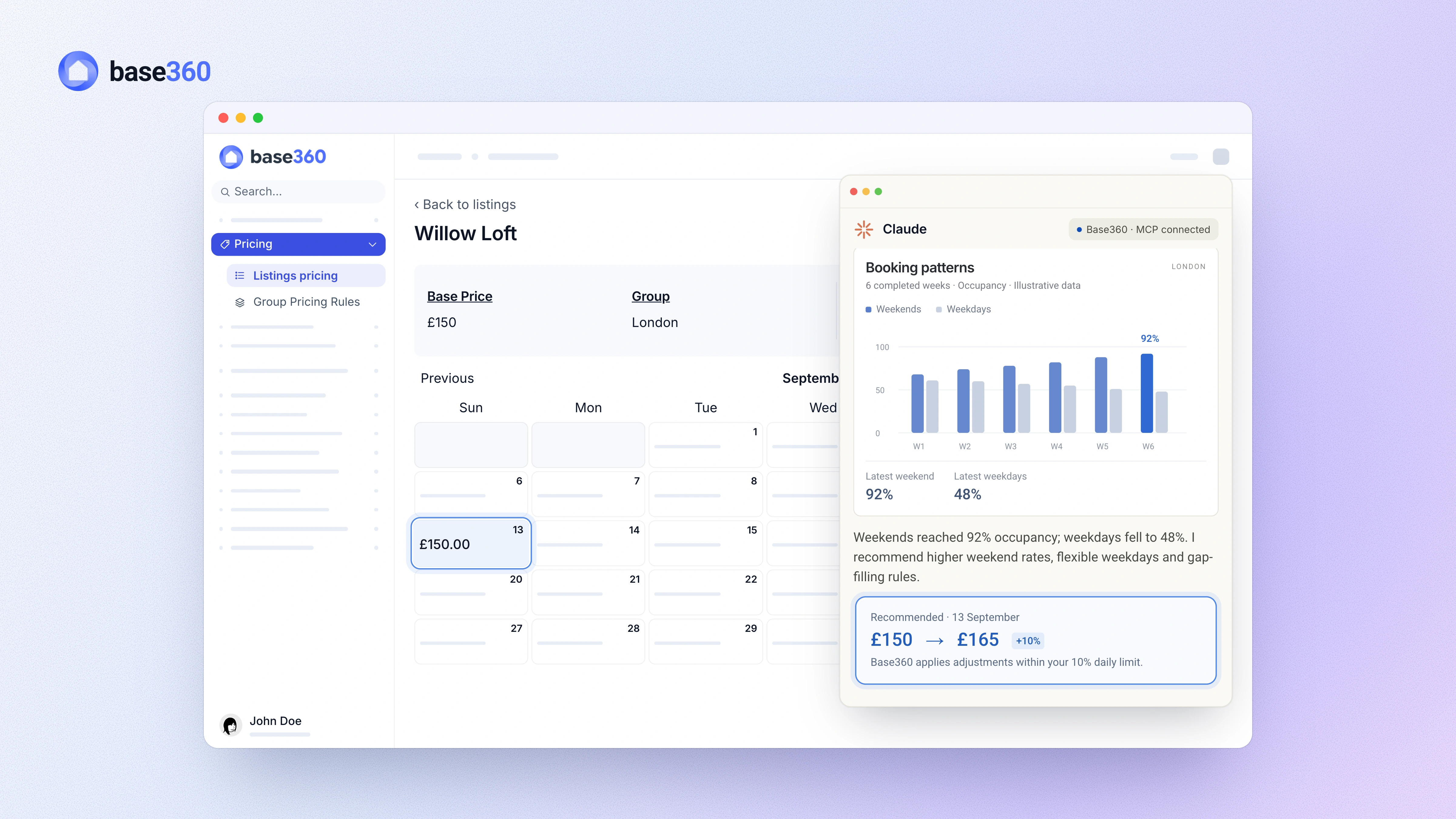
What connecting Claude to a PMS means
Pricing is the job that never quite gets finished. You set seasons and minimum stays in spring, and by August three flats are empty midweek while the rest are full. Somebody has to notice, work out why, and change the rates, and that somebody is usually you, late on a Sunday, with four tabs open.
The Base360 MCP server moves that work into a conversation. We built it so Claude can reach your occupancy, pricing and finance data in Base360, tell you what stands out, and propose a change. When you agree, Claude saves the new prices back through the same server. MCP, the Model Context Protocol, is the open standard that lets an AI assistant work inside another piece of software, and the Base360 MCP server is our side of it.
Monday, 08:55John Doe runs operations for fourteen London listings and has twenty minutes before his first call. He wants to know how August went and whether September needs changing.
So the rest of this guide follows John’s Monday morning, from the first connection to the moment the new prices are saved.
Connecting Claude to Base360
Connecting Claude to Base360 takes one consent screen, and that screen is where you decide how far Claude can go. You add Base360 as a connection in Claude and sign in with your Base360 account. Base360 then shows what Claude is asking for: properties and reservations, performance and finance, and prices.
Monday, 09:00John opens Claude, picks Base360 from the tools menu and signs in. A short screen from Base360 asks what Claude may do: look at his properties and finance, and look at and change prices. He allows it. Nothing else changes in Base360.
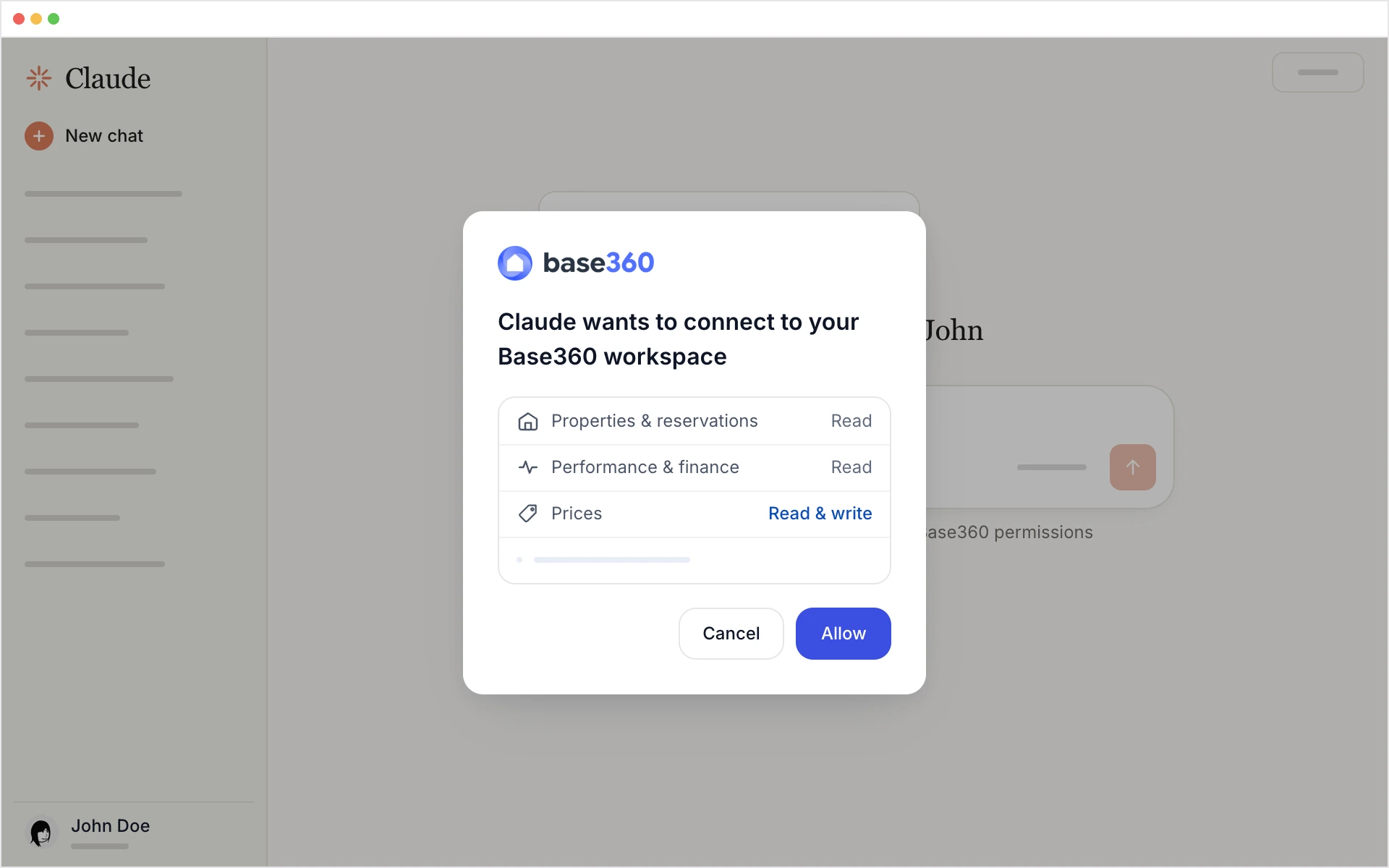
The one real decision on this screen is how far Claude can go, and it comes down to prices. With looking only, Claude becomes a sharp analyst: it tells you which listings are behind, since when, and why, and you make the change yourself. With changing prices allowed too, Claude can act on its own answer, but it still asks before every change, so nothing moves without your yes. If you are unsure, start with looking only for a week and switch prices on once its answers match what you see in Base360. Either way, Claude works inside each person’s own Base360 role, so a teammate who cannot edit prices in Base360 cannot edit them through Claude either.
TipConnect with the account of the person who owns pricing. Claude sees what that person sees, no more.
Asking how the portfolio performed
Once connected, you ask in plain words, and Claude works out what to look up in Base360. For “how did August go?” it checks which listings you have and how full each one was that month, then replies with the number and the story behind it.
Monday, 09:02John types one question: “How did August go?” Claude looks up his listings and their bookings in Base360, then answers in plain words. The portfolio was 74% full, and three flats, Cedar Studio, Harbor House and Willow Loft, were clearly behind the rest.
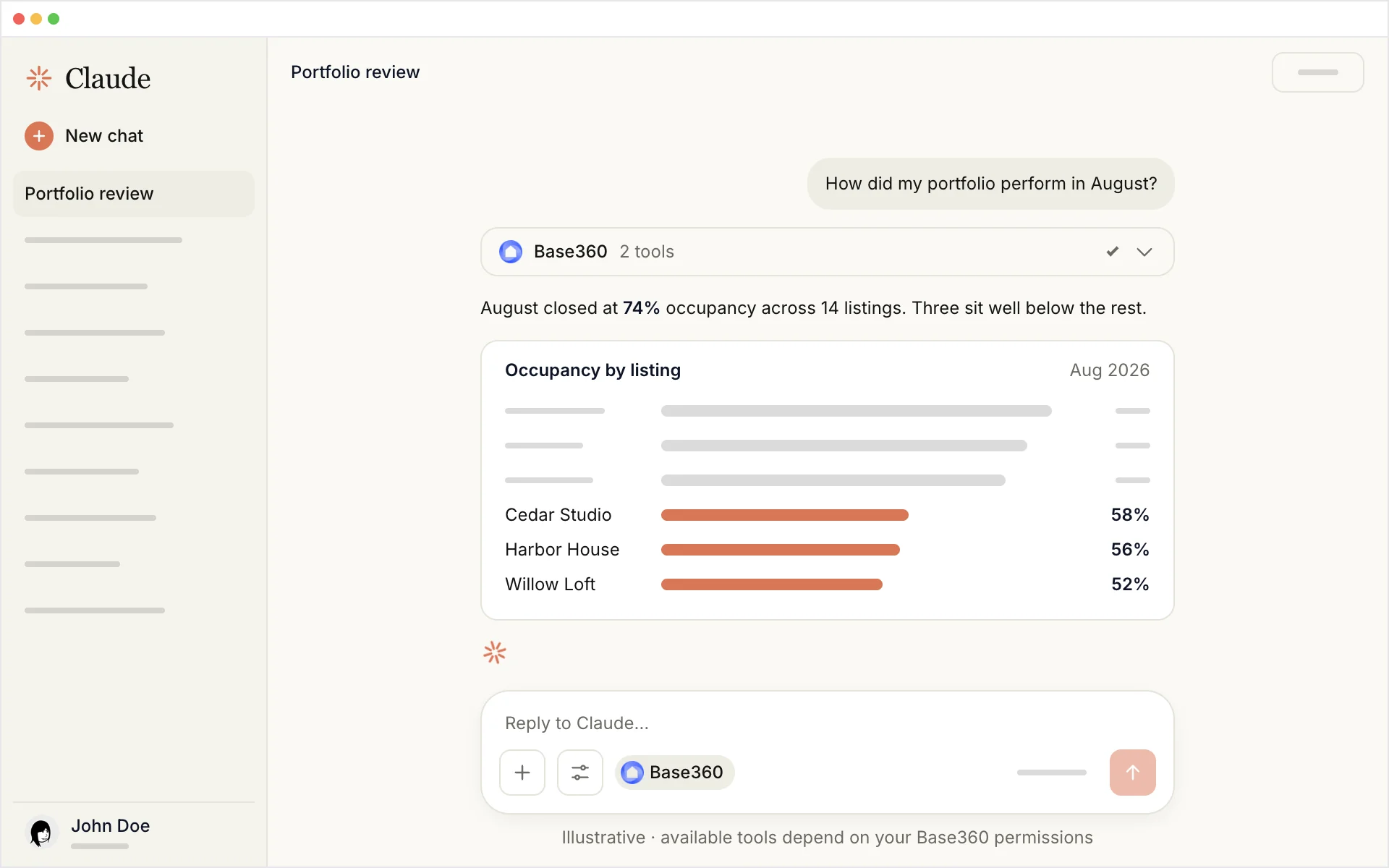
Above every answer, Claude shows what it looked up, so you can see where a number came from before you act on it. That is the habit worth building early: glance at that line, and if a figure surprises you, open the same page in Base360 and compare.
Finding the pricing opportunity
A low number is only useful once you know why it is low, so the next question is about cause. Claude reads the current rates and a finance summary, and looks for the pattern the three weak listings share.
Monday, 09:05Claude pulls September rates and July to August finance. Two things stand out: all three listings fall below 60% on weekdays, and Harbor House’s net revenue is down 14% on July. Claude suggests lowering weekday prices by 8% on those three for September.
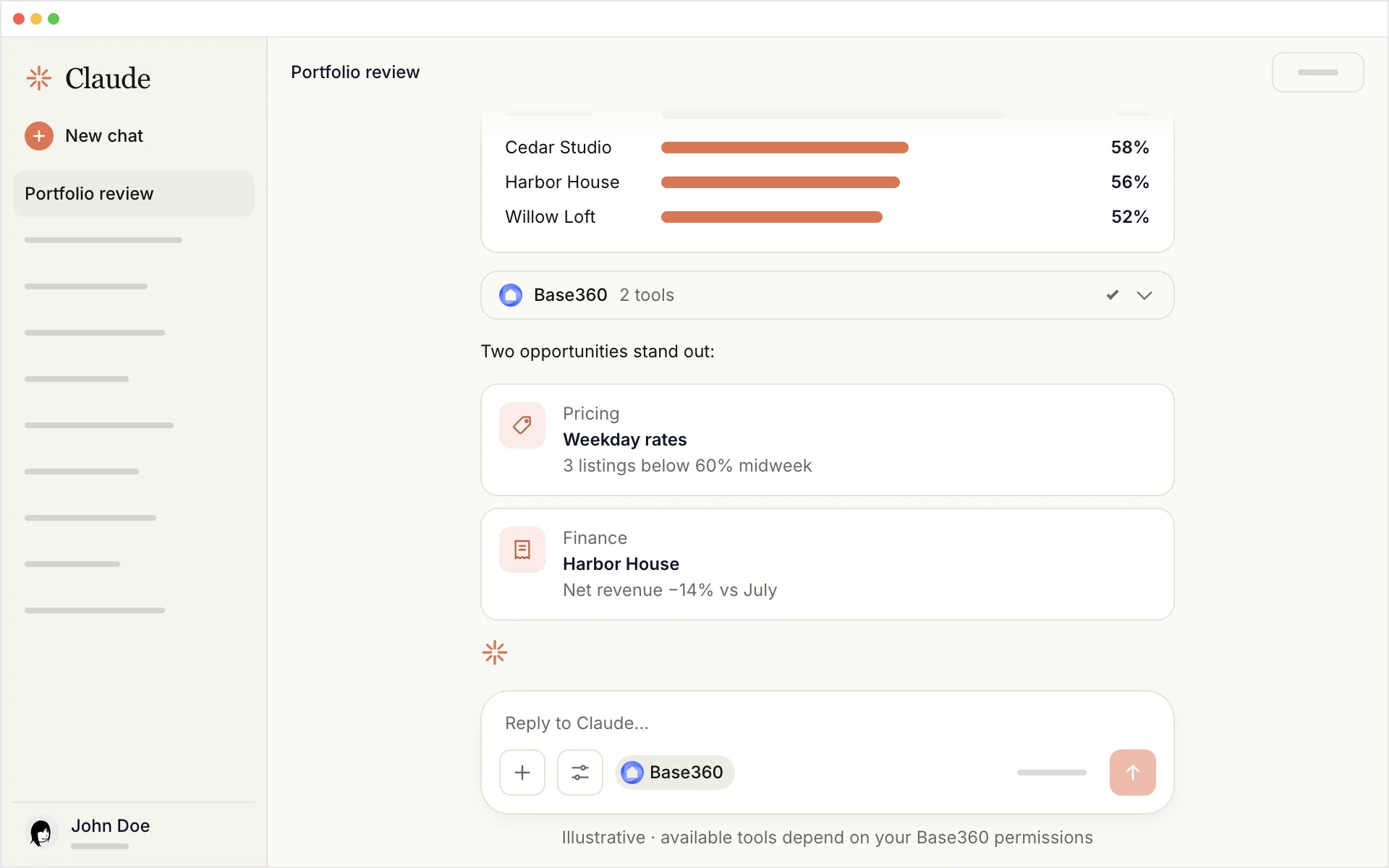
Your decision at this point is how narrow to keep the change. A good proposal names the listings, the dates and the size of the change, and leaves the rest of the portfolio alone. If Claude suggests something broad, ask it to show the listings it would touch first.
TipAsk Claude for last year’s sold-out dates too. They are the other half of pricing, the dates worth a higher rate.
Approving a price change
This is the moment the conversation turns into prices, and it only happens with your yes. Before Claude changes a price, it asks, and it shows exactly what it is about to change.
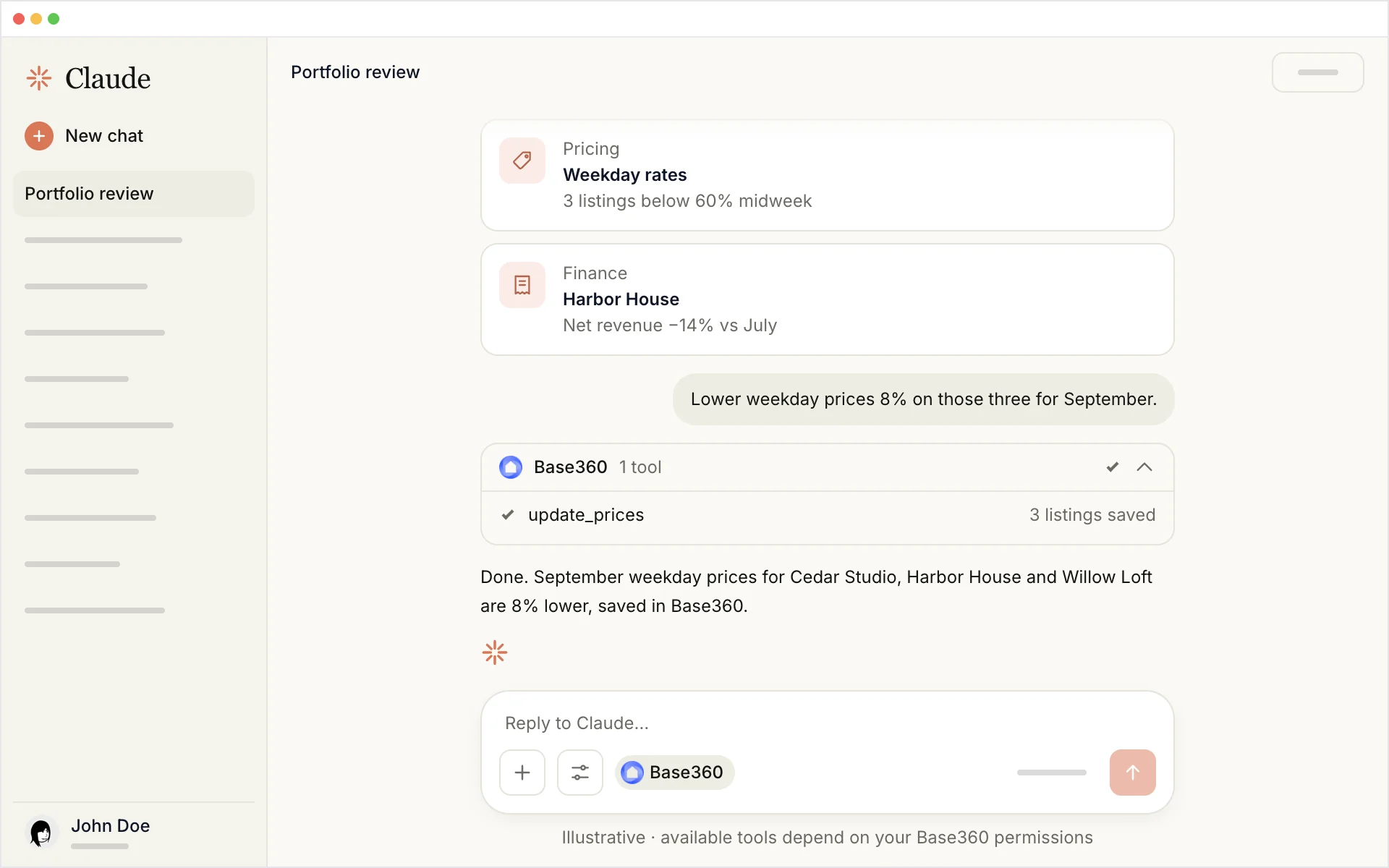
Monday, 09:07Before it changes anything, Claude asks: lower September weekday prices by 8% on these three flats? John clicks Allow once. A second later Claude confirms the new weekday prices for Cedar Studio, Harbor House and Willow Loft are saved in Base360.
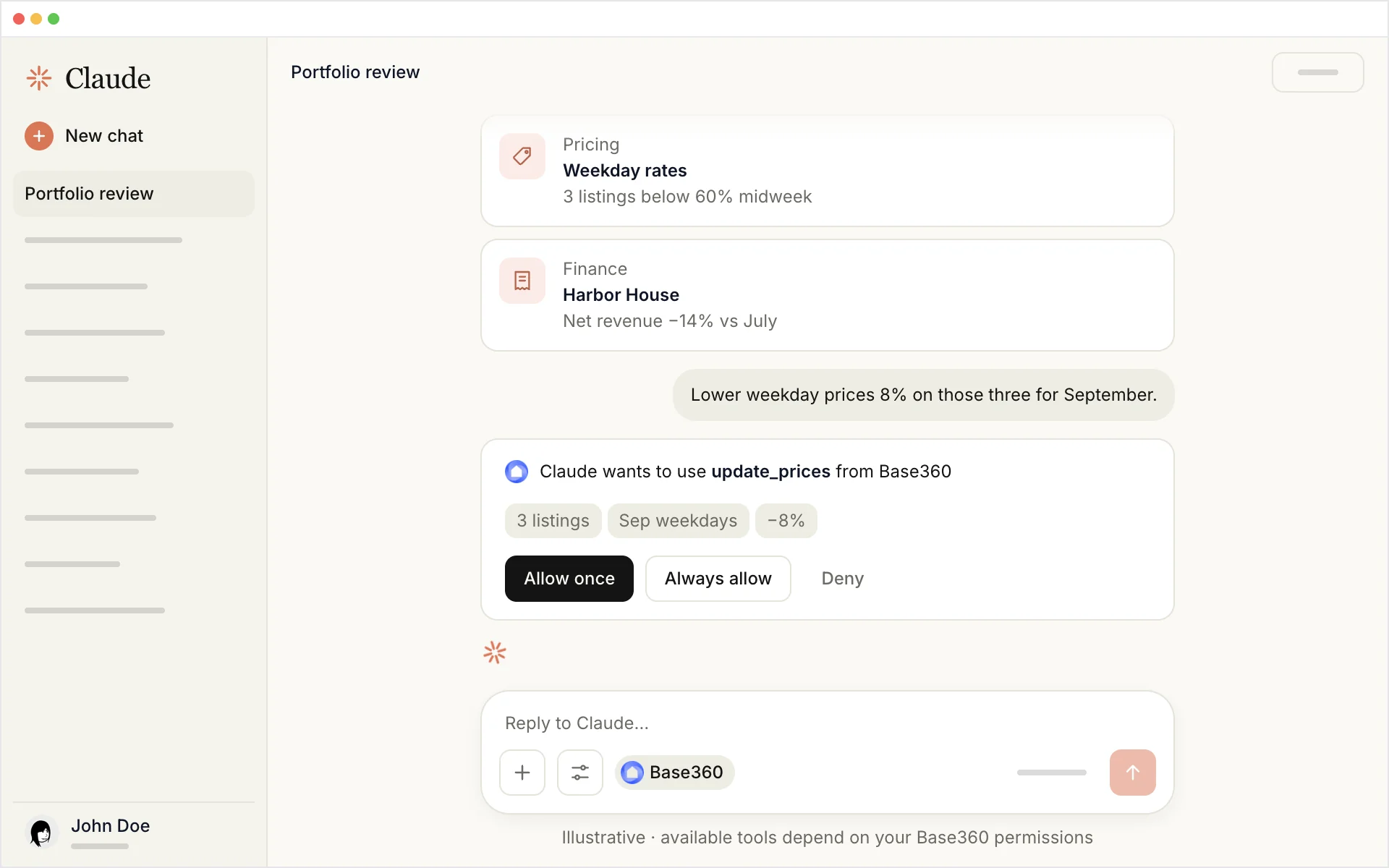
You choose between Allow once, Always allow and Deny. We keep Allow once for price changes, because each approval is a short review of what is about to go live. The change lands in Base360’s pricing, where your minimum stays, seasons and group rules still apply around it.
Good to knowBase360’s minimum price is not a floor for every source. A fixed override or a PriceLabs value can go below it, so check the calendar after a large change.
How Base360 builds each nightly price
So where does John’s 8% actually go? Claude is not pricing from a blank page. Every listing in Base360 already has a pricing setup behind it, and Claude’s change becomes one more part of it.
That setup starts with a base price and a minimum price for each listing. On top of them sit the rules you share across a group of listings: seasonal adjustments for the busy and quiet months, discounts or increases as occupancy rises and falls, and minimum stays, including shorter ones close to arrival and for the small gaps between bookings. For one-off dates, like a festival weekend, you can set a fixed price.
Base360 works all of this out night by night. That is why the calendar can explain any single date: open it and you see the base, the season, the occupancy step and any override that made the final number. After Claude saves a change, that same view is the quickest way to check the result.
That leaves the question most operators ask before they switch anything on: could Claude suddenly set a silly price? No, because Base360 limits how far a rate can move. A price can change by up to 10% in a day and 20% in a week. Anything bigger is not applied on its own. It goes to a person on your team, who approves it or turns it down.
TipGet the base and minimum prices right first. Claude’s suggestions are only as good as the setup they build on, and those two numbers anchor everything else.
From Base360 to your channels
A saved price is not yet a live price on Airbnb, so the last step is getting it to the channels. Base360 queues the new prices for synchronisation through your connected channel manager, and each channel then accepts the update.
That is also why two pricing systems never fight over one rate. If PriceLabs manages a property, PriceLabs stays in charge of it, and Base360 turns down price changes to it, from Claude or from anyone else. Claude can still read and explain that listing, but the rate comes from PriceLabs.
Monday, 11:30John opens Willow Loft on Airbnb and sees the lower Tuesday rate. The whole change took one conversation and one approval, and nobody on his team had to rebuild a pricing spreadsheet.
Keeping a person in charge
An assistant that can change prices needs limits, and in Base360 they are built in before you type your first question. Three of them work together. Claude can only see and do what your Base360 role allows. It asks before every price change unless you tell it otherwise, and it shows everything it looked up. And Base360 itself caps how far a rate can move, 10% in a day and 20% in a week, sending anything bigger to a person on your team to approve.
This is how AI autopilot works in Base360. You set your prices, rules and limits once, and Base360 with Claude does the daily work: reading the numbers, spotting the gaps and proposing the right change at the right time. You set the direction, and a change outside your limits never happens without you. The same idea runs through AI agent workflows in Base360, where agents handle the routine and hand the judgement calls to your team.
TipKeep one conversation per month of pricing. Next month, you can ask Claude what it changed last time and how those dates performed.
Questions STR operators ask
Can Claude change my prices in Base360?
Yes, as long as you allow it. Once you connect Claude to the Base360 MCP server and give it permission to change prices, Claude can read your listings’ performance, recommend changes and save the prices you approve back into Base360. Claude asks before it changes a price, and it only sees what your Base360 permissions allow.
What is MCP?
MCP, the Model Context Protocol, is an open standard that lets an AI assistant such as Claude work with another application’s data. Base360 runs its own MCP server, which is how Claude reaches your listings, only as far as you allow it. Base360 offers Claude a short list of things it can do, like finding your listings, checking how full they are or changing a price, and Claude uses them when your question needs them.
Do I need a developer or an API key to connect Claude to my PMS?
Not with Base360. You add Base360 as a connection in Claude, sign in, and choose on one short screen what Claude may look at and change. Without it, the usual route is custom code that a developer has to write and keep working.
Will Claude change prices without asking me?
Not unless you tell it to. Claude asks before it changes anything, and you can allow it once, always allow it, or deny it. Even with Always allow, Base360’s daily and weekly limits still apply. We suggest Allow once until you trust the pattern of changes it proposes.
Is it safe to let AI change my Airbnb prices?
In Base360, yes, because the limits sit in the PMS rather than in the AI. A price can move by up to 10% in a day and 20% in a week, and anything bigger goes to a person on your team to approve. Claude also asks before every change and only sees what your Base360 role allows.
Do new prices go straight to Airbnb and Booking.com?
Not instantly. Prices saved in Base360 are sent on through your connected channel manager, and each channel then has to accept the update. After a large change, open the listing on Airbnb or Booking.com to check it.
I use PriceLabs. Can Claude still set my prices?
For properties that PriceLabs manages, PriceLabs stays the pricing authority and Base360 turns down price changes to them, so there are never two systems setting the same rate. Claude can still read those properties and explain their performance.
Can ChatGPT connect to Base360 as well?
Yes. ChatGPT can connect to the Base360 MCP server too, and it only sees the data you allow. This guide follows Claude, the assistant we used to walk through it step by step.